Tuesday, August 26, 2025

Thursday, February 13, 2025
Friday, February 7, 2025
Thursday, February 6, 2025
WEB SUGGESTIONS- Categorized list of free certifications, learning platforms, and resources for students
Here’s an categorized list with resources for Data Science, Machine Learning (ML), and Generative AI:👇
1. Free Virtual Work Experience Programs
- Forage – Virtual internships with top companies like TATA, Accenture, PWC, Deloitte, etc.
🔗 Visit Forage
2. Free Data Science, Machine Learning & AI Certifications
- Kaggle – Free courses on SQL, Python, Machine Learning (ML), Deep Learning (DL).
🔗 Visit Kaggle Learn - Infosys Springboard – Free courses and certifications in AI, ML, and more.
🔗 Visit Infosys Springboard - Great Learning – Free certification courses in data science, ML, AI.
🔗 Visit Great Learning Academy - Fast.ai – Practical deep learning courses for AI & ML beginners.
🔗 Visit Fast.ai
3. Generative AI & Deep Learning
- Google AI Learning – Free courses on ML, AI, Generative AI, TensorFlow, and more.
🔗 Visit Google AI - Microsoft AI for Beginners – Free AI and deep learning courses.
🔗 Visit Microsoft AI - OpenAI Learning – Guides on Generative AI, ChatGPT, and advanced AI models.
🔗 Visit OpenAI - DeepLearning.AI (by Andrew Ng) – Free ML & AI courses including ChatGPT and Generative AI.
🔗 Visit DeepLearning.AI - Meta AI Learning – Free AI & ML training from Meta (Facebook).
🔗 Visit Meta AI
4. Project-Based Learning (Data Science & AI)
- CampusX (YouTube Channel) – Hands-on data science and ML projects.
🔗 Watch Sample Project - Papers with Code – Research papers with code implementations in AI & ML.
🔗 Visit Papers with Code
5. Free Courses on Coursera
- Python Programming
- C Programming
6. Aptitude & Placement Preparation
- Indiabix – Aptitude, logical reasoning, and interview preparation.
🔗 Visit Indiabix - PrepInsta – Placement preparation and aptitude practice.
🔗 Visit PrepInsta - CareerRide (YouTube Channel) – Aptitude and interview preparation.
These resources will help students learn Data Science, ML, and Generative AI for free and build hands-on experience! 🚀
Some reputable companies offering free data science certifications
Here are some reputable companies offering free data science certifications that are beneficial for students:
IBM Data Science Professional Certificate: Offered through Coursera, this program consists of nine courses covering topics such as data science fundamentals, Python programming, data visualization, and machine learning. Upon completion, learners receive a professional certificate from IBM.
Great Learning's Free Data Science Courses: Great Learning Academy provides a variety of free courses in data science, including topics like Python, machine learning, and data visualization. These courses are designed to help learners build foundational skills and offer a certificate upon completion.
Simplilearn's Free Data Science Courses: Simplilearn offers free courses that cover various aspects of data science, such as business analytics with Excel, data science with Python, and data visualization. These courses are tailored to enhance your understanding and provide a completion certificate.
DataCamp's Free Data Science Courses: DataCamp provides free access to introductory courses in data science, focusing on programming languages like Python and R, as well as data analysis and visualization techniques. While some content requires a subscription, there are free courses available that include interactive exercises.
These certifications can help you build valuable skills in data science and enhance your resume. Be sure to check the specific requirements and time commitments for each program to find the best fit for your learning goals.
Thursday, July 25, 2024
Graph Traversal - BFS
Write a C program for finding the Breadth First Search of a graph.
// C program for finding the Breadth First Search of a graph
#include <stdio.h>
#include <stdlib.h>
#define MAX_VERTICES 100
// Function to add an edge to the graph
void addEdge(int graph[MAX_VERTICES][MAX_VERTICES], int start, int end) {
graph[start][end] = 1;
graph[end][start] = 1; // For undirected graph
}
// Function to perform BFS traversal
void BFS(int graph[MAX_VERTICES][MAX_VERTICES], int vertices, int startVertex) {
int visited[MAX_VERTICES] = {0}; // Initialize all vertices as not visited
int queue[MAX_VERTICES];
int front = -1, rear = -1,i;
// Mark the startVertex as visited and enqueue it
visited[startVertex] = 1;
queue[++rear] = startVertex;
printf("BFS Traversal Order: ");
while (front != rear) {
int currentVertex = queue[++front];
printf(" %d --> ", currentVertex);
for ( i = 0; i < vertices; i++) {
if (graph[currentVertex][i] == 1 && !visited[i]) {
visited[i] = 1;
queue[++rear] = i;
}
}
}
printf("\n");
}
// Function to print the adjacency matrix
void printAdjacencyMatrix(int graph[MAX_VERTICES][MAX_VERTICES], int vertices) {
int i, j;
printf("Adjacency Matrix:\n");
for (i = 0; i < vertices; i++) {
for (j = 0; j < vertices; j++) {
printf("%d ", graph[i][j]);
}
printf("\n");
}
}
int main() {
int vertices, edges,i;
printf("\n****Breadth-First Search (BFS) traversal****\n");
printf("-----------------------------------------------\n");
// Input the number of vertices
printf("Input the number of vertices: ");
scanf("%d",&vertices);
if (vertices <= 0 || vertices > MAX_VERTICES) {
printf("Invalid number of vertices. Exiting...\n");
return 1;
}
int graph[MAX_VERTICES][MAX_VERTICES] = {0}; // Initialize the adjacency matrix with zeros
// Input the number of edges
printf("Input the number of edges: ");
scanf("%d",&edges);
if (edges < 0 || edges > vertices * (vertices - 1) / 2) {
printf("Invalid number of edges. Exiting...\n");
return 1;
}
// Input edges and construct the adjacency matrix
for (i = 0; i < edges; i++) {
int start, end;
printf("Input edge %d (start end): ", i + 1);
scanf("%d %d", &start, &end);
// Validate input vertices
if (start < 0 || start >= vertices || end < 0 || end >= vertices) {
printf("Invalid vertices. Try again.\n");
i--;
continue;
}
addEdge(graph, start, end);
}
// Print the adjacency matrix
printAdjacencyMatrix(graph, vertices);
// Input the starting vertex for BFS traversal
int startVertex;
printf("Input the starting vertex for BFS traversal: ");
scanf("%d", &startVertex);
if (startVertex < 0 || startVertex >= vertices) {
printf("Invalid starting vertex. Exiting...\n");
return 1;
}
// Perform BFS traversal
BFS(graph, vertices, startVertex);
return 0;
}


Wednesday, July 24, 2024
Graph Traversal - DFS
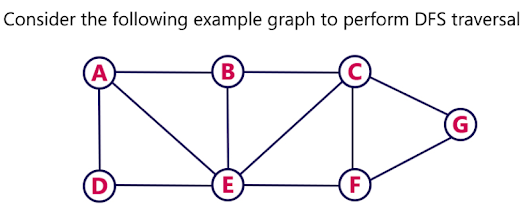
Write a C program for finding the Depth First Search of a graph.
//C program for finding the Depth First Search of a graph.
#include <stdio.h>
#define MAX_VERTICES 100
// Function to perform Depth-First Search (DFS) traversal
void DFS(int graph[MAX_VERTICES][MAX_VERTICES], int visited[MAX_VERTICES], int vertices, int start) {
int i;
printf(" %d --> ", start); // Print the current vertex
visited[start] = 1; // Mark the current vertex as visited
// Visit all adjacent vertices
for (i = 0; i < vertices; i++) {
if (graph[start][i] == 1 && !visited[i]) {
DFS(graph, visited, vertices, i);
}
}
}
// Function to print the adjacency matrix
void printAdjacencyMatrix(int graph[MAX_VERTICES][MAX_VERTICES], int vertices) {
int i, j;
printf("Adjacency Matrix:\n");
for (i = 0; i < vertices; i++) {
for (j = 0; j < vertices; j++) {
printf("%d ", graph[i][j]);
}
printf("\n");
}
}
int main() {
int vertices, edges, i, j;
printf("\n****Depth-First Search (DFS) traversal****\n");
printf("-----------------------------------------------\n");
// Input the number of vertices
printf("Enter the number of vertices: ");
scanf("%d", &vertices);
if (vertices <= 0 || vertices > MAX_VERTICES) {
printf("Invalid number of vertices. Exiting...\n");
return 1;
}
int graph[MAX_VERTICES][MAX_VERTICES] = {0}; // Initialize the adjacency matrix with zeros
int visited[MAX_VERTICES] = {0}; // Initialize the visited array with zeros
// Input the number of edges
printf("Enter the number of edges: ");
scanf("%d", &edges);
if (edges < 0 || edges > vertices * (vertices - 1)) {
printf("Invalid number of edges. Exiting...\n");
return 1;
}
// Input edges and construct the adjacency matrix
for (i = 0; i < edges; i++) {
int start, end;
printf("Enter edge %d (start end): ", i + 1);
scanf("%d %d", &start, &end);
// Validate input vertices
if (start < 0 || start >= vertices || end < 0 || end >= vertices) {
printf("Invalid vertices. Try again.\n");
i--;
continue;
}
graph[start][end] = 1;
// For directed graph, comment the following line:
graph[end][start] = 1;
}
// Print the adjacency matrix
printAdjacencyMatrix(graph, vertices);
// Input the starting vertex for DFS traversal
int startVertex;
printf("Enter the starting vertex for DFS traversal: ");
scanf("%d", &startVertex);
if (startVertex < 0 || startVertex >= vertices) {
printf("Invalid starting vertex. Exiting...\n");
return 1;
}
printf("DFS Traversal Order: ");
DFS(graph, visited, vertices, startVertex);
return 0;
}
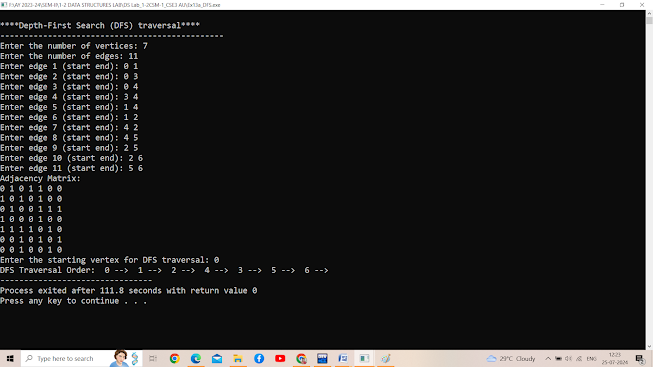
Input/Output:
Friday, July 19, 2024
Dijkstra's algorithm(single-source shortest path problem)-Source Code in C
Write a C program for finding the shortest path from a given source to any vertex in a digraph using Dijkstra’s algorithm.
/*This program prompts the user to input the number of vertices, edges, and the cost of each edge.
It then prints the adjacency matrix and calculates the shortest path from the source vertex to all other vertices using Dijkstra's algorithm.*/
#include <stdio.h>
#include <limits.h>
#define NO_EDGE -1
void printGraph(int graph[][50], int V) {
int i, j;
printf("\nThe adjacency matrix is:\n");
for (i = 0; i < V; i++) {
for (j = 0; j < V; j++) {
if (graph[i][j] == NO_EDGE)
printf("%4d ", 0);
else
printf("%4d ", graph[i][j]);
}
printf("\n");
}
}
int minDistance(int dist[], int sptSet[], int V) {
int min = INT_MAX, min_index;
int vertex;
for (vertex = 0; vertex < V; vertex++) {
if (sptSet[vertex] == 0 && dist[vertex] <= min) {
min = dist[vertex];
min_index = vertex;
}
}
return min_index;
}
void printPath(int parent[], int j) {
if (parent[j] == -1)
return;
printPath(parent, parent[j]);
printf(" -> %d", j + 1); // Adjusting to one-based index for output
}
void drawGraph(int graph[][50], int V) {
int i, j;
printf("\nGraph representation (nodes and edges):\n");
for (i = 0; i < V; i++) {
printf("Node %d:\n", i + 1);
for (j = 0; j < V; j++) {
if (graph[i][j] != NO_EDGE) {
printf(" -> Node %d (Cost: %d)\n", j + 1, graph[i][j]);
}
}
}
}
void printSolution(int dist[], int parent[], int V, int src) {
int i;
printf("Vertex\t Distance\tPath");
for (i = 0; i < V; i++) {
printf("\n%d -> %d \t\t %d\t\t%d", src + 1, i + 1, dist[i], src + 1); // Adjusting to one-based index for output
printPath(parent, i);
}
printf("\n");
}
void dijkstra(int graph[][50], int src, int V) {
int dist[50];
int sptSet[50];
int parent[50];
int i, count, vertex;
for (i = 0; i < V; i++) {
dist[i] = INT_MAX;
sptSet[i] = 0;
parent[i] = -1;
}
dist[src] = 0;
for (count = 0; count < V - 1; count++) {
int u = minDistance(dist, sptSet, V);
sptSet[u] = 1;
for (vertex = 0; vertex < V; vertex++) {
if (!sptSet[vertex] && graph[u][vertex] != NO_EDGE && dist[u] != INT_MAX && dist[u] + graph[u][vertex] < dist[vertex]) {
dist[vertex] = dist[u] + graph[u][vertex];
parent[vertex] = u;
}
}
}
printSolution(dist, parent, V, src);
}
int main() {
int V, E, i, j;
printf("****Dijkstra\'s algorithm(single-source shortest path problem)*****\n");
printf("------------------------------------------------------------------\n");
printf("Enter the number of vertices: ");
scanf("%d", &V);
int graph[50][50];
for (i = 0; i < V; i++) {
for (j = 0; j < V; j++) {
graph[i][j] = NO_EDGE;
}
}
printf("Enter the number of edges: ");
scanf("%d", &E);
printf("Enter the end vertices of each edge and its cost (one-based index):\n");
for (i = 0; i < E; i++) {
int u, v, cost;
printf("Edge %d: ", i + 1);
scanf("%d %d %d", &u, &v, &cost);
graph[u - 1][v - 1] = cost; // Adjusting to zero-based index
}
printGraph(graph, V);
drawGraph(graph, V);
int src;
printf("\nEnter the source vertex (one-based index): ");
scanf("%d", &src);
dijkstra(graph, src - 1, V); // Adjusting to zero-based index
return 0;
}
INPUT/OUTPUT
Testcase1: for the graph


****Dijkstra's algorithm(single-source shortest path problem)*****
-------------------------------------------------------------------------------------------
Enter the number of vertices: 6
Enter the number of edges: 9
Enter the end vertices of each edge and its cost (one-based index):
Edge 1: 1 2 4
Edge 2: 1 3 5
Edge 3: 2 3 11
Edge 4: 2 4 9
Edge 5: 2 5 7
Edge 6: 3 5 3
Edge 7: 4 5 13
Edge 8: 4 6 2
Edge 9: 5 6 6
The adjacency matrix is:
0 4 5 0 0 0
0 0 11 9 7 0
0 0 0 0 3 0
0 0 0 0 13 2
0 0 0 0 0 6
0 0 0 0 0 0
Graph representation (nodes and edges):
Node 1:
-> Node 2 (Cost: 4)
-> Node 3 (Cost: 5)
Node 2:
-> Node 3 (Cost: 11)
-> Node 4 (Cost: 9)
-> Node 5 (Cost: 7)
Node 3:
-> Node 5 (Cost: 3)
Node 4:
-> Node 5 (Cost: 13)
-> Node 6 (Cost: 2)
Node 5:
-> Node 6 (Cost: 6)
Node 6:
Enter the source vertex (one-based index): 1
Vertex Distance Path
1 -> 1 0 1
1 -> 2 4 1 -> 2
1 -> 3 5 1 -> 3
1 -> 4 13 1 -> 2 -> 4
1 -> 5 8 1 -> 3 -> 5
1 -> 6 14 1 -> 3 -> 5 -> 6
--------------------------------
Process exited after 114.5 seconds with return value 0
Press any key to continue . . .
Testcase2: for the graph


****Dijkstra's algorithm(single-source shortest path problem)*****
------------------------------------------------------------------
Enter the number of vertices: 9
Enter the number of edges: 14
Enter the end vertices of each edge and its cost (one-based index):
Edge 1: 1 2 4
Edge 2: 1 8 8
Edge 3: 2 8 11
Edge 4: 2 3 8
Edge 5: 8 9 7
Edge 6: 8 7 1
Edge 7: 3 9 2
Edge 8: 9 7 6
Edge 9: 7 6 2
Edge 10: 3 6 4
Edge 11: 3 4 7
Edge 12: 4 6 14
Edge 13: 6 5 10
Edge 14: 4 5 9
The adjacency matrix is:
0 4 0 0 0 0 0 8 0
0 0 8 0 0 0 0 11 0
0 0 0 7 0 4 0 0 2
0 0 0 0 9 14 0 0 0
0 0 0 0 0 0 0 0 0
0 0 0 0 10 0 0 0 0
0 0 0 0 0 2 0 0 0
0 0 0 0 0 0 1 0 7
0 0 0 0 0 0 6 0 0
Graph representation (nodes and edges):
Node 1:
-> Node 2 (Cost: 4)
-> Node 8 (Cost: 8)
Node 2:
-> Node 3 (Cost: 8)
-> Node 8 (Cost: 11)
Node 3:
-> Node 4 (Cost: 7)
-> Node 6 (Cost: 4)
-> Node 9 (Cost: 2)
Node 4:
-> Node 5 (Cost: 9)
-> Node 6 (Cost: 14)
Node 5:
Node 6:
-> Node 5 (Cost: 10)
Node 7:
-> Node 6 (Cost: 2)
Node 8:
-> Node 7 (Cost: 1)
-> Node 9 (Cost: 7)
Node 9:
-> Node 7 (Cost: 6)
Enter the source vertex (one-based index): 1
Vertex Distance Path
1 -> 1 0 1
1 -> 2 4 1 -> 2
1 -> 3 12 1 -> 2 -> 3
1 -> 4 19 1 -> 2 -> 3 -> 4
1 -> 5 21 1 -> 8 -> 7 -> 6 -> 5
1 -> 6 11 1 -> 8 -> 7 -> 6
1 -> 7 9 1 -> 8 -> 7
1 -> 8 8 1 -> 8
1 -> 9 14 1 -> 2 -> 3 -> 9
--------------------------------
Process exited after 191.6 seconds with return value 0
Press any key to continue . . .
Tuesday, July 16, 2024
Warshall’s Algorithm to find Transitive
Closure
What is the Transitive Closure of a Graph?
The transitive closure of a graph is a data structure that
represents all the shortest paths between the nodes of the graph. More
specifically, given a directed graph G = (V, E), the transitive closure is a
new graph G' = (V, E'), where there is an edge (u, v) in E' if there is a path
from u to v in G. In other words, the transitive closure of a graph is a
compact representation of all the reachability information in the graph.
There are different methods to compute the transitive closure of
a graph, including the Floyd-Warshall algorithm, the dynamic programming
approach, and the matrix multiplication method. The choice of the method
depends on the specific problem and the properties of the graph.
Real-World Examples of Transitive Closure
The concept of transitive closure can be applied to various
real-world scenarios, such as:
Social Networks: In a social network like Facebook or LinkedIn, users are
connected through friendships or professional connections. The transitive
closure of the social network graph can be used to analyze the reachability
between users and find the shortest path between them.
Web Crawling: Search engines like Google use web crawlers to index websites.
The transitive closure of the web graph can be used to determine the
reachability between different web pages and prioritize the crawling process.
Transportation Networks: In a transportation network,
cities or stations are connected through roads, railways, or air routes. The
transitive closure of the transportation network graph can be used to compute
the shortest paths between cities or stations, which is essential for route
planning and optimization.
Dependency Management: In software development, modules
or packages often depend on other modules or packages. The transitive closure
of the dependency graph can be used to determine the full set of dependencies
for a given module or package, which is important for software building and
distribution.
SOURCE CODE in C
/*This is a C Program to find Transitive Closure of a Digraph using Warshall’s Algorithm*/
#include<stdio.h>
#include<conio.h>
#include<math.h>
int max(int,int);
void warshal(int p[10][10],int n) {
int i,j,k;
for(k=1;k<=n;k++)
for(i=1;i<=n;i++)
for(j=1;j<=n;j++)
p[i][j]=max(p[i][j],p[i][k]&&p[k][j]);
}
int max(int a,int b) {
if(a>b)
return(a);
else
return(b);
}
void main() {
int p[10][10]={0},n,e,u,v,i,j;
printf("****Transitive Closure of a Digraph using Warshall’s Algorithm*****\n\n");
printf("Enter the number of vertices:");
scanf("%d",&n);
printf("Enter the number of edges:");
scanf("%d",&e);
for(i=1;i<=e;i++) {
printf("Enter the end vertices of edge %d:",i);
scanf("%d%d",&u,&v);
p[u][v]=1;
}
printf("\n Adjacency Matrix of input data: \n");
for(i=1;i<=n;i++) {
for(j=1;j<=n;j++)
printf("%d\t",p[i][j]);
printf("\n");
}
warshal(p,n);
printf("\n Transitive closure: \n");
for(i=1;i<=n;i++) {
for(j=1;j<=n;j++)
printf("%d\t",p[i][j]);
printf("\n");
}
}
INPUT/ OUTPUT:

****Transitive Closure of a Digraph using WarshallÆs Algorithm*****
Enter the number of vertices:4
Enter the number of edges:4
Enter the end vertices of edge 1:1 2
Enter the end vertices of edge 2:2 4
Enter the end vertices of edge 3:4 1
Enter the end vertices of edge 4:4 3
Adjacency Matrix of input data:
0 1 0 0
0 0 0 1
0 0 0 0
1 0 1 0
Transitive closure:
1 1 1 1
1 1 1 1
0 0 0 0
1 1 1 1
--------------------------------
Process exited after 94.09 seconds with return value 4
Press any key to continue . . .